Some Personality Traits That Are Closely Related to the Rational-Irrational Dichotomy
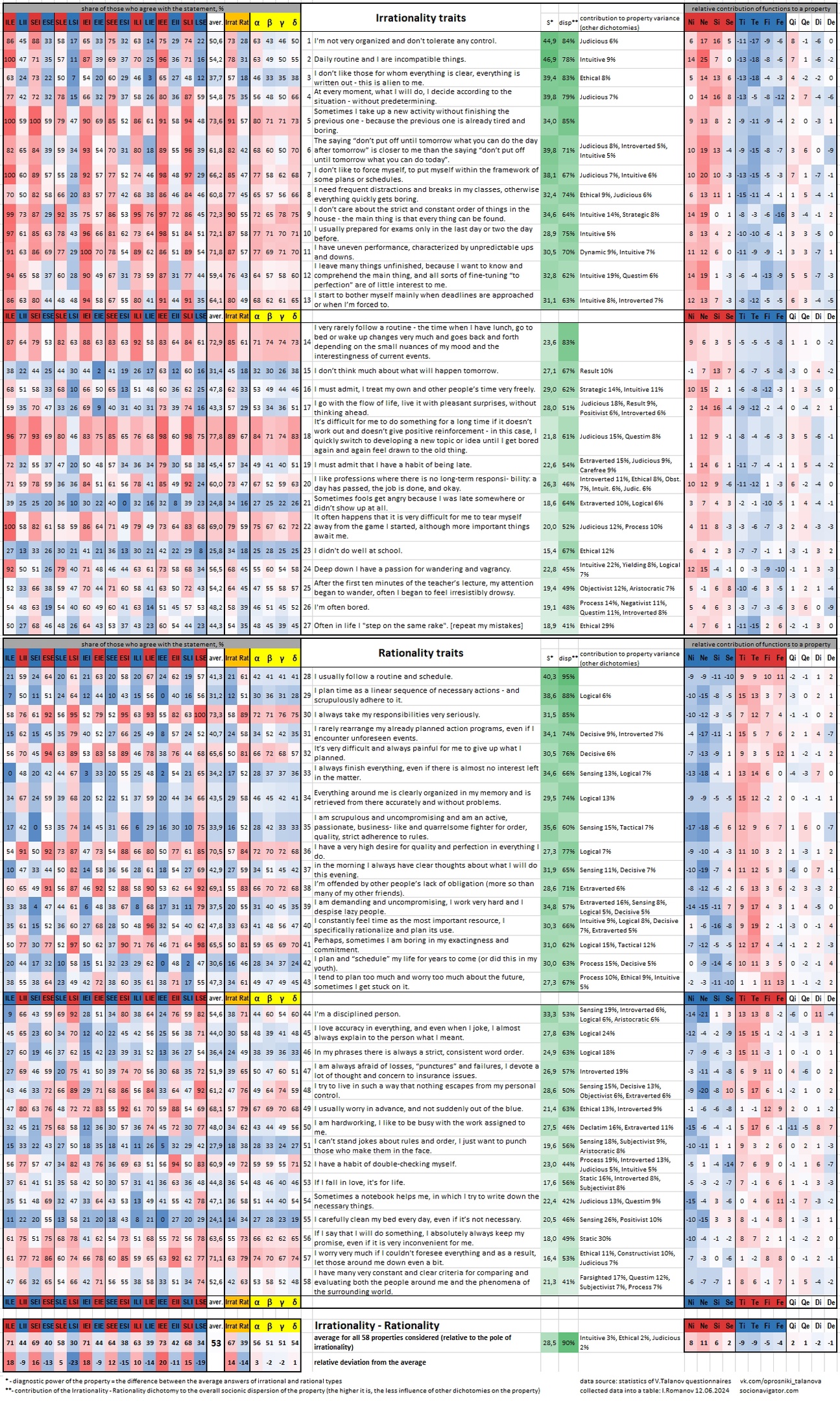
Conclusions:
The semantic core of RATIONALITY is self-control and planning of one's behavior in time. Self-control is usually felt as a kind of preoccupation/concern:
* in Ti - it is a concern about the observance of a static order (a system of principles, rules and laws, once accepted as correct);
* in Te - concern that every minute of time is not wasted, but is occupied with useful work (the fastest and most economical approach to the next goal);
* in Fi - concern about the social acceptability of one's actions (which generates social anxiety when it is necessary to perform any activity, the result of which the subject is not completely sure/as a result of which the subject is not completely sure/);
* in Fe - concern about the impression created by oneself and one's actions in the eyes of others (which generates pain at any deviation from what is perceived as an ideal, beautiful order).
On the contrary, the semantic core of IRRATIONALITY is non-planning, the desire to throw off any control. The irrational component of various functions manifests itself in the form of a certain freedom from obligations:
* in Ni - it is a refusal/rejection of responsibility for other people, an unwillingness to burden oneself with social burdens;
* in Ne - refusal to force oneself and others to do anything, the desire to reject what is prescribed as duties and do only what is of interest;
* in Si - refusal to plan the future, one's ascending/upward career and often associated overstrain and mental deformations;;
* in Se - refusal to take into account in one's actions what consequences they lead to for other people.
“"Concern" is the wrong word. The top issues are inertia, the inability to turn off the planned path and the actions already being performed.”
I agree, bad choice. In my "social energy theory" the rational is likened to a vector. That is, a rational is someone who once chose a direction (of movement or location) relative to something or someone, thereby voluntarily reducing the number of degrees of freedom, and then constantly monitors whether he has deviated from this direction. It will be necessary to think more over the formulations, their translation into "human" language, these were written rather as an illustration to the tables.