Some Personality Traits That Are Closely Related to the Extraversion-Introversion Dichotomy
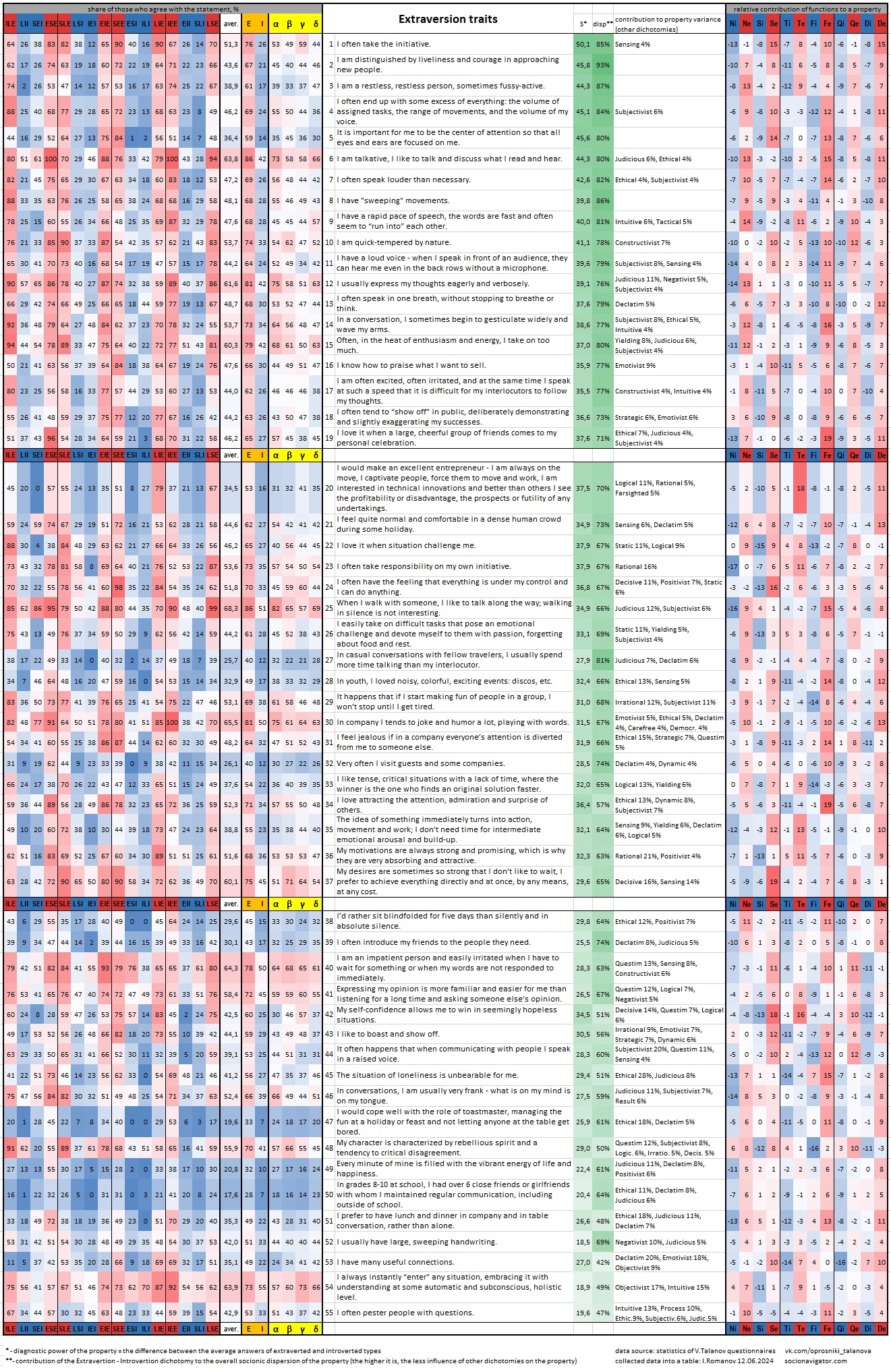
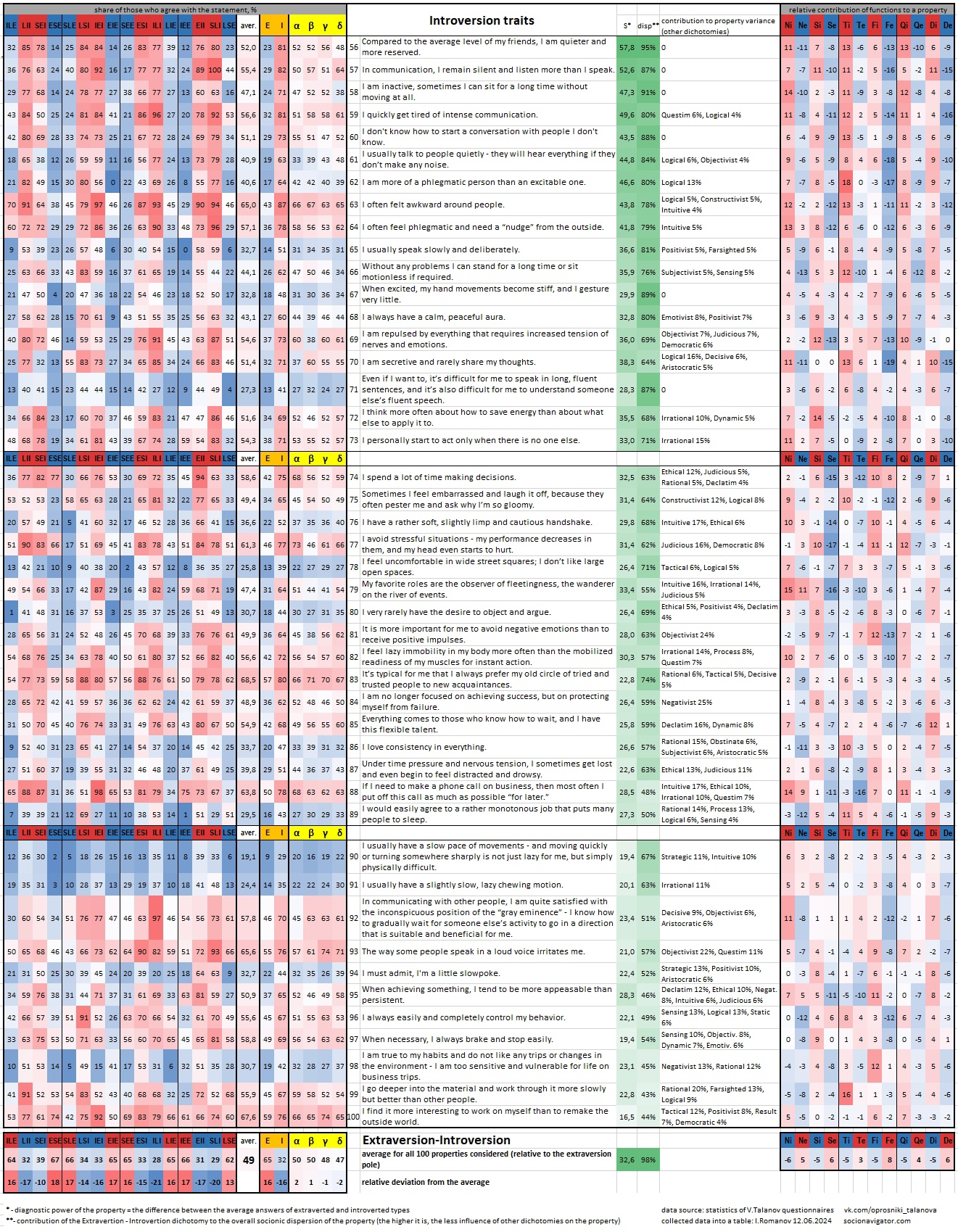
Conclusions:
The semantic core of EXTRAVERSION is the general activity of the personality (physical, behavioral, verbal, mental), the dominance of excitation reactions in mental activity, their strength and speed of occurrence. An extrovert can be called a person who has a higher level of activity than the average participant in the surrounding social environment; therefore, an extrovert is an energy donor who brings an impulse to society with his activity, prompting it to change.
The available energy is redistributed into different spheres and, depending on the leading function, gives rise to the following qualities:
Fe - sociability, desire to influence a lot of people, desire to be in the center of attention;
Te - vigor/energy in work, speed of decision-making and transition from idea to action;
Se - self-confidence, desire to get what one wants as quickly as possible, the speed of spontaneous reaction when it is necessary to attack or fight back;
Ne - frequency of change of thought-images in the internal flow of imagination (“leap of ideas”), accelerated flow of speech, fidgetiness//restlessness, tendency to scatter, often change decisions;
Qe - irritability, impatience, irascibility, anger;
De - contact, relaxed behavior, ease of orientation in a large company or crowd, the ability to situationally unite with people and unite others.
For INTROVERSION, the semantic core is the predominance of inhibition reactions in the psyche, the result of which is low observable activity of the personality. In society, an introvert is someone who has an activity level lower than the average participant in the surrounding social environment and is, in fact, its inert element. If the advantage of an extrovert is the ability to make changes in society and the world around them, then an introvert more effectively preserves and supports the functioning of existing systems, orders, relationships; preventing their degradation, disintegration, loss of resources and opportunities contained in them.
Depending on the leading function, the following qualities come to the fore in the introverted personality:
Si - calmness, ease of inhibition/braking in any activity when necessity, desire to save physical strength and preserve health as the main reason to stop and not to hurry;
Ni - immersion in oneself, apathy, a position of non-interference, unwillingness to be active and open up to anyone for fear of losing one's role as an observer sitting in the shadows who can slip away at any moment in case of a threat;
Fi - constraint/restraint of actions and external reactions due to social fears (fear of offending someone, causing inconvenience by one's activity, etc.);
Ti - preference for an unchanging, well-known environment due to the reluctance to enter into new social contacts when changing the environment (which are especially energy-consuming when cognitive empathy is weak);
Qi - preference for solitude - due to unwillingness to experience social stress, internal discomfort and insecurity (unlike the subject of Fi, the subject of Qi is not afraid of injuring someone, but of others injuring him/her).
Di - ability to wait patiently, humbly submitting to circumstances;